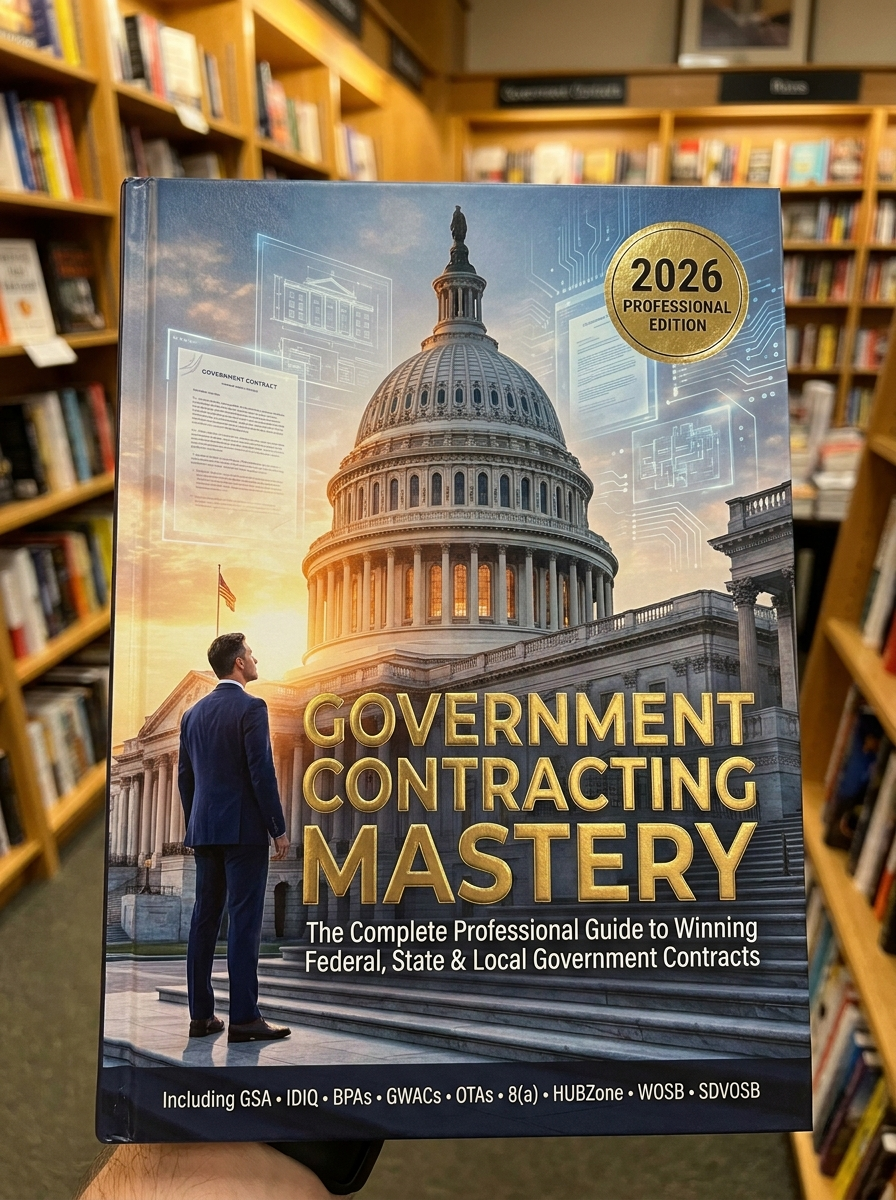
The US government spends approximately $759 billion a year on contracts. State and local governments add hundreds of billions more. Most businesses never win a single one — not because they lack capability, but because they don't understand how government purchasing actually works. This manual explains the entire system, end to end.
Federal, state, and local procurement combined form the largest single marketplace in the American economy — and it's structurally different from every other market you've sold into. This manual is the operating manual for that system.
Governed by the FAR/DFARS. The largest, most regulated, and most document-intensive tier — and the one this manual covers in the most depth.
Governed by individual state procurement codes — different rules, different portals, often less competition than federal.
Highly fragmented, wide variation in process — many jurisdictions use informal purchasing well below formal bid thresholds.
Education, transit, water, port, and utility authorities — often overlooked, often less competitive.
The federal government targets 23% of eligible prime contract dollars for small businesses — with additional sub-goals for 8(a), HUBZone, WOSB, and SDVOSB firms.
Certified 8(a) firms can receive sole-source awards up to $4.5M for most industries — up to $25M for DoD, NASA, and Coast Guard, with zero competition.
A week-by-week plan from your first day of SAM.gov setup through your first proposal submission — not just theory, a schedule.
By the time a solicitation posts, the real competition already knows the agency, the program, and the incumbent. Winning requires market intelligence before the RFP drops.
Registration is a prerequisite, not a strategy. Contracts are won through capability statements, relationship building, and targeted business development — not passive listing.
Without past performance you can't compete for significant contracts; without contracts you can't build past performance. Experienced contractors break in through a specific set of proven entry strategies — subcontracting first among them.
Meeting every checkbox in the solicitation isn't the same as writing a proposal that wins. Win themes, discriminators, and evaluator psychology matter as much as compliance.
Every stage of the procurement process, from business setup to a seven-figure exit.
How the acquisition system actually works, entity setup for government contracting, and NAICS/PSC code selection — including revenue-cap tables by code (e.g. $45M average size standard for commercial/industrial construction).
Complete guide to 8(a), HUBZone, WOSB, and SDVOSB certification (eligibility thresholds, sole-source ceilings), building a capability statement that gets read, and where real opportunities surface before they're publicly posted.
Win-theme development and evaluator psychology, government contract pricing models (FFP, cost-plus, T&M), and how to structure teaming agreements, joint ventures, and subcontracts.
Performance management and CPARS ratings, automation tools for pipeline and compliance tracking, and the operating model for scaling into a seven-figure government contracting business.
GSA Multiple Award Schedules, IDIQ contracts, Blanket Purchase Agreements, Government-Wide Acquisition Contracts (GWACs), Other Transaction Agreements (OTAs), competitive intelligence, and the seven-figure business model.
SAM.gov registration checklist, bid/no-bid decision matrix, proposal compliance matrix, capability statement template, GSA Schedule application checklist, pricing worksheet, CPARS response framework, glossary, decision trees, chapter action plans, and a week-by-week 90-day implementation blueprint.
No subscription. No upsells. Pay once. Get everything.
Secure checkout · Card, Apple Pay, Google Pay · Instant delivery
No. Certifications open up set-aside contracts and sole-source opportunities, but any registered business can compete for full-and-open contracts. Section 4 walks through every certification's eligibility requirements and whether pursuing one makes sense for your business.
Yes, but not by bidding on major primes on day one. Bonus Chapter G covers the proven first-contract strategies experienced contractors use to break the past-performance chicken-and-egg problem, including subcontracting under an established prime.
No. While federal procurement (governed by the FAR) gets the deepest coverage, the manual also covers state, county, municipal, school district, and special district procurement — each with materially different rules and often less competition than federal.
A single comprehensive document — the full curriculum, bonus chapters, complete toolkit, and 90-day blueprint in one file, delivered instantly.
Government contracting consultants and proposal specialists charge thousands for guidance covering a fraction of this material. This guide gives you the full operating system — certifications, contract vehicles, pricing, proposal strategy, and a 90-day execution plan — for a fraction of that.
Every week without a capability statement, a certification strategy, and a real pipeline is a week your competitors spend building past performance you'll eventually have to compete against.
Get Instant Access — $29Instant download · One-time payment · All content included